

Website United Nations Development
Organizational Context: The Role of UNDP in Global Development
UNDP operates in nearly 170 countries and territories, working to eradicate poverty, reduce inequalities, and build resilience so nations can sustain progress. Unlike specialized agencies, UNDP takes a holistic approach to development, integrating areas like governance, climate change, economic recovery, and crisis prevention. An entry-level assistant role is a critical support function within this complex machinery. These positions are designed as a first step for recent graduates and young professionals, offering immersive exposure to program management, policy analysis, and multi-stakeholder coordination in some of the world’s most challenging and dynamic contexts.
Analysis of the Entry-Level Assistant Role
The title “Assistant” within UNDP encompasses a family of positions, typically at the General Service (GS) or National Professional Officer (NPO) level, which provide administrative, program, and operational support.
Primary Purpose: To deliver efficient and effective support to a specific team, unit, or country office, enabling the smooth implementation of development projects and the day-to-day functioning of the office. Assistants are the operational backbone, ensuring that experts and managers can focus on substantive program delivery.
Common Role Classifications:
-
Programme/Project Assistant: Supports the management of specific development projects, assisting with workplan tracking, budget monitoring, report compilation, and partner coordination.
-
Administrative/Executive Assistant: Provides high-level support to a senior manager or unit, managing schedules, communications, travel, and meetings.
-
Operations/Finance Assistant: Works within the operations team on procurement, human resources, finance processing, and logistics.
-
Communications Assistant: Supports the development and dissemination of public outreach materials, social media content, and donor reports.
Detailed Breakdown of Compensation and Benefits
The advertised package is a significant part of the role’s value proposition, especially for entry-level professionals.
-
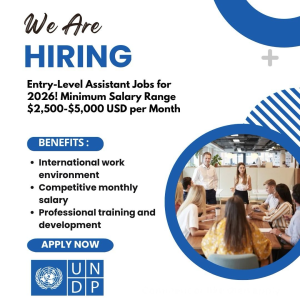
Salary Range ($2,500 – $5,000 USD per month): This is a competitive international salary. The exact offer within this band is determined by:
-
Duty Station: Salaries are calibrated to the local cost of living (post-adjustment). A position in a high-cost duty station (e.g., Geneva, New York) would be at the higher end, while a position in a national country office might fall in the lower to middle range.
-
Experience and Qualifications: Relevant prior experience, even at the intern or volunteer level, can influence the starting step within the grade level.
-
Contract Type: Fixed-term appointments for internationally recruited staff typically follow the UN Common System salaries and benefits.
-
-
International Work Environment: This is a defining feature. Assistants work alongside a diverse cohort of colleagues from around the world, engaging in a multicultural setting that operates in English and often a local language. This provides unparalleled cross-cultural competency development.
-
Professional Training and Development: UNDP invests heavily in its personnel. This includes:
-
Mandatory Induction: Onboarding into UN rules, procedures, and ethics.
-
Technical Skill Training: Courses on project management (e.g., PRINCE2), financial reporting, procurement, and specific development topics.
-
Career Development Resources: Access to the UN’s online learning platforms (UN System Staff College) and potential support for further academic study.
-
Core Qualifications and Desired Candidate Profile
UNDP seeks candidates who are not only proficient but who embody the principles of the United Nations Charter.
-
Academic Requirements: A first-level university degree (Bachelor’s degree or equivalent) in Business Administration, Public Administration, Finance, Economics, International Relations, Political Science, Communications, or a related field is typically mandatory.
-
Experience: While “entry-level,” some relevant experience is often expected. This can include:
-
1-2 years of progressively responsible administrative, program, or operational experience.
-
Substantive internships with international organizations, NGOs, government, or the private sector.
-
Volunteer work, especially in community development or related fields, is highly valued.
-
-
Language Proficiency: Fluency in English is required for most international posts. Working knowledge of another UN official language (Arabic, Chinese, French, Russian, Spanish) is a significant competitive advantage and is required for many duty stations.
-
Core Competencies & Behavioral Indicators:
-
Accountability & Delivery: Demonstrates reliability in meeting deadlines and managing assigned tasks with a high degree of accuracy.
-
Digital Literacy: Advanced proficiency in Microsoft Office 365 suite (especially Excel, PowerPoint, Teams, SharePoint) and the ability to learn enterprise resource planning (ERP) systems like Quantum (the UN’s financial system).
-
Teamwork & Collaboration: Proven ability to work effectively in a team of people from diverse cultural and professional backgrounds.
-
Planning & Organizing: Excellent organizational and time-management skills.
-
Client Orientation: A service-minded approach to supporting colleagues and external partners.
-
The Application and Rigorous Selection Process
The process for a UN entry-level position is lengthy, transparent, and highly competitive, often involving thousands of applicants per post.
-
Portal Application – UNDP Jobs/UN Inspira: All applications must be submitted through the UNDP Jobs website or the unified UN Inspira recruitment platform. This system uses automated screening.
-
Strategic Application Components:
-
Personal History Profile (PHP)/Resume: This must be meticulously detailed, following the UN format. It should quantify achievements (e.g., “processed 50+ purchase orders,” “supported a $2M project portfolio,” “coordinated logistics for a 200-person conference”).
-
Motivational Statement/Cover Letter: This is critical. It must explicitly link your skills and values to UNDP’s work, mentioning specific Strategic Plan priorities (e.g., digitalization, green transition) and demonstrating knowledge of the development context.
-
-
Assessment Stages:
-
Technical Screening: Your application is screened against the mandatory and desirable criteria listed in the vacancy announcement.
-
Written Assessment: Shortlisted candidates may be asked to complete a timed written exercise, such as drafting a briefing note, analyzing data, or preparing a meeting summary.
-
Competency-Based Interview: A panel interview using the UN’s competency framework. Questions will be behavioral (e.g., “Describe a time you managed a heavy workload under pressure.”) and situational (e.g., “How would you handle a request from a partner that violates procurement rules?”).
-
Reference Checks: Rigorous checks of academic and professional references are standard.
-
Long-Term Career Trajectory and Considerations
An entry-level assistant role is a launchpad for a meaningful international career.
-
Career Pathway: High-performing assistants can progress to Associate and then Officer levels (P-level posts) through internal promotion or by applying to higher-level vacancies across the UN system. The experience and network gained are invaluable.
-
Mobility: While the first assignment may be in a specific country office, the UN system encourages geographical and functional mobility, offering opportunities to work in different regions and thematic areas over time.
-
Considerations: The process is slow, often taking 6-9 months from application to offer. The work can be process-driven within a large bureaucracy. Assignments may be in challenging or remote duty stations.
To apply for this job please visit lnkd.in.