
Website Barrick Gold Corporation
Project and Regional Context: The Guyana-Suriname Basin
Guyana has emerged as a premier global offshore oil province following a series of major discoveries in the Stabroek Block. The project involves floating production, storage, and offloading (FPSO) vessels operating in deepwater environments. Working on this project means being part of a frontier development that is transforming a nation’s economy and requires the highest international standards of safety, environmental stewardship, and operational excellence. The remote offshore setting demands a rotational work schedule, typically 28 days on/28 days off, with personnel living on the FPSO or associated offshore accommodation vessels during their hitch.
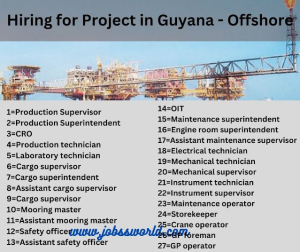
Analysis of Position Categories and Hierarchy
The listed roles span the entire offshore production hierarchy, from senior management to entry-level operators. They can be grouped into several core departments.
1. Production & Operations Department
This department is responsible for the core process of extracting, treating, and exporting hydrocarbons.
-
Production Superintendent (#2): The senior manager overseeing all production activities on the asset. Responsible for production targets, budget management, and overall process safety.
-
Production Supervisor (#1): Reports to the superintendent, directly managing shift teams of technicians and operators to ensure daily production goals are met safely.
-
Control Room Operator (CRO) (#3): A critical role operating the vessel’s Distributed Control System (DCS) from the central control room, monitoring and adjusting process parameters 24/7.
-
Production Technician (#4): Conducts rounds, performs equipment checks, troubleshoots process issues, and executes routine operational tasks under the supervisor’s direction.
-
Laboratory Technician (#5): Tests crude oil, produced water, and chemical injections to ensure product specifications and process efficiency are maintained.
2. Marine & Cargo Department
Manages the offloading of processed crude oil to shuttle tankers, a high-risk marine operation.
-
Mooring Master (#10) / Assistant Mooring Master (#11): Licensed mariners responsible for the safe mooring and unmooring of offloading tankers alongside the FPSO, a precision operation in open ocean conditions.
-
Cargo Superintendent (#7) / Supervisor (#6, #9) / Assistant (#8): Manages the crude oil custody transfer process, including tank gauging, valve line-ups, and strict adherence to Tanker Safety Guide (TSG) and Ship/Shore Safety Checklists.
3. Health, Safety, Security & Environment (HSSE) Department
The non-negotiable priority on any offshore installation.
-
Safety Officer (#12) / Assistant Safety Officer (#13): Implements the project’s HSSE management system. Conducts inspections, audits, incident investigations, and safety training. Ensures compliance with OSHA, ISO 45001, and company-specific life-saving rules.
4. Maintenance & Engineering Department
Ensures the mechanical integrity and reliability of all equipment, from turbines to valves.
-
Maintenance Superintendent (#15) / Engine Room Superintendent (#16): Senior leaders for mechanical/rotating equipment and marine systems, respectively. They set maintenance strategy and manage the department’s budget and KPIs.
-
Mechanical Supervisor (#20) / Electrical Technician (#18) / Instrument Technician (#21) / Mechanical Technician (#19): Skilled tradespeople responsible for preventative and corrective maintenance on specific equipment classes (pumps, compressors, generators, control systems, instrumentation).
-
Instrument Supervisor (#22): Leads the team maintaining all process control, safety instrumented systems (SIS), and field instrumentation.
-
Assistant Maintenance Supervisor (#17): Supports planning and coordination of daily maintenance activities.
-
Maintenance Operator (#23): Often a semi-skilled role assisting technicians and performing basic lubrication and filter changes.
5. Logistics, Deck & Support Services
Supports the material and personnel logistics of the offshore operation.
-
Storekeeper (#24): Manages the offshore warehouse, inventory of spare parts, and the computerized maintenance management system (CMMS) for issuing materials.
-
Crane Operator (#25): Operates pedestal cranes for loading supplies from supply vessels and handling equipment on deck. Requires specialized offshore certification.
-
General Purpose (GP) Foreman (#26) / GP Operator (#27): Deck crew responsible for lifting operations, rigging, scaffolding, painting, and general fabric maintenance.
-
Oil-in-Water (OIT) Monitor / Operator (#14): A specialized environmental role monitoring discharged water to ensure it meets stringent regulatory standards for oil content.
Work Environment and Rotational Schedule
Life offshore is unique and requires specific personal adaptability.
-
Rotation: The standard is an equal-time rotation (e.g., 28 days on, 28 days off). Travel to and from the vessel is typically by helicopter from an onshore base.
-
Living Conditions: Personnel live in shared cabins on the FPSO or support vessel. Facilities include cafeterias, gyms, recreation rooms, and internet access, but personal space is limited.
-
Work Culture: Safety is paramount. The culture is one of absolute procedural adherence, continuous hazard awareness, and clear communication. The environment is multicultural, with crews from around the world.
Core Qualifications and Mandatory Certifications
Offshore survival and safety training is non-negotiable. Most roles will require:
-
Basic Safety Training (BST): Including Basic Offshore Safety Induction and Emergency Training (BOSIET) with Compressed Air Emergency Breathing System (CA-EBS), Helicopter Underwater Escape Training (HUET), and Offshore Firefighting.
-
Medical Certification: A fit-for-duty medical exam, often following OGUK or similar standards.
-
Technical & Role-Specific Requirements:
-
Superintendent/Supervisor Roles: 10+ years of offshore experience, often with an engineering degree, and proven leadership in a similar setting.
-
Technician/Rated Roles: A relevant trade certification (Electrical, Instrumentation, Mechanical) and 5+ years of hands-on experience, preferably on FPSOs or similar offshore production facilities.
-
Marine Roles (Mooring Master): A valid Master Mariner (Unlimited) license and extensive experience in offshore dynamic positioning (DP) or mooring operations.
-
Safety Roles: A NEBOSH International General Certificate or equivalent, with offshore safety experience.
-
Compensation, Benefits, and Contract Structure
Offshore roles in frontier developments command premium compensation packages.
-
Salary: Salaries are typically day-rates paid only for days worked offshore, but annualized they are highly competitive and often tax-advantaged depending on contract structure. Superintendent roles can command daily rates exceeding $800-$1,200+ USD.
-
Benefits: Packages usually include:
-
Completion Bonuses
-
Comprehensive International Health Insurance
-
Travel Allowances for rotations
-
Disability and Life Insurance
-
-
Contract Type: Most hires are on a long-term single-status rotational contract through an international staffing agency or a direct contract with the operator/primary contractor.
Application Process and Strategic Guidance
The post directs applicants to www.jobssworld.com, which appears to be a third-party recruitment portal.
-
Due Diligence is Critical:
-
Verify the Recruiter: Research “jobssworld.com” thoroughly. Check for reviews, contact information, and legitimacy. A legitimate agency will have a professional website, LinkedIn presence, and verifiable contact details.
-
Never Pay Fees: You should never pay an application or processing fee for a job.
-
-
Preparing Your Application:
-
Offshore-Specific CV: Your CV must list all relevant certifications with expiry dates, specific equipment experience (e.g., Siemens turbines, Yokogawa DCS), and previous vessels/FPSOs by name.
-
Highlight Safety: Emphasize your safety record and familiarity with permit-to-work (PTW) systems, job safety analysis (JSA), and behavior-based safety programs.
-
-
Interview Preparation:
-
Expect technical interviews focusing on specific troubleshooting scenarios (e.g., “What would you do if a pump seal failed?”).
-
Behavioral interviews will heavily focus on safety leadership, team conflict resolution, and procedural compliance.
-
Be prepared to provide extensive references from previous offshore assignments.
-
Important Considerations and Final Summary
Working offshore in Guyana is a career-defining opportunity but comes with significant demands. It offers high earnings potential, unparalleled technical experience on world-class assets, and a unique rotational lifestyle. However, it requires long periods away from home, strict adherence to safety protocols, and the ability to work in a closed, high-pressure environment.
This recruitment drive seeks experienced offshore professionals to staff a world-scale project. Candidates must prioritize verifying the legitimacy of the recruitment channel, ensuring their certifications are current, and presenting a CV that demonstrates a proven track record of safe, competent performance in the specific offshore discipline to which they are applying.
To Apply & Important Disclaimer:
-
Proceed with Caution: The job post directs to
www.jobssworld.com. Applicants should exercise extreme diligence to confirm this is a legitimate recruitment agency before submitting any personal information. -
Preferred Method: Seasoned offshore professionals are advised to also apply directly through the careers websites of major operators (e.g., ExxonMobil, Hess, CNOOC) and primary contractors (e.g., SBM Offshore, MODEC, Saipem) known to be active in Guyana.
-
Required Documentation: Have a digital folder ready with your CV, scanned copies of all safety certifications, trade certificates, passport, and seaman’s book (if applicable).
To apply for this job please visit bit.ly.